
The textile recycling industry is gaining momentum as environmental concerns grow, and both consumers and businesses look for ways to reduce their ecological footprint. With the global textile industry contributing significantly to pollution, the need for sustainable practices has never been more pressing. The rise of textile recycling presents an opportunity to address waste issues while supporting the industry’s transition toward a circular economy.
Market Growth and Trends
The textile recycling market is experiencing notable growth. According to a recent report by Allied Market Research, the global textile recycling market is expected to reach $9.14 billion by 2030, growing at a compound annual growth rate (CAGR) of 5.7% from 2022 to 2030. This growth is driven by increasing awareness of environmental issues, coupled with the need for companies to comply with stricter regulations on waste disposal.
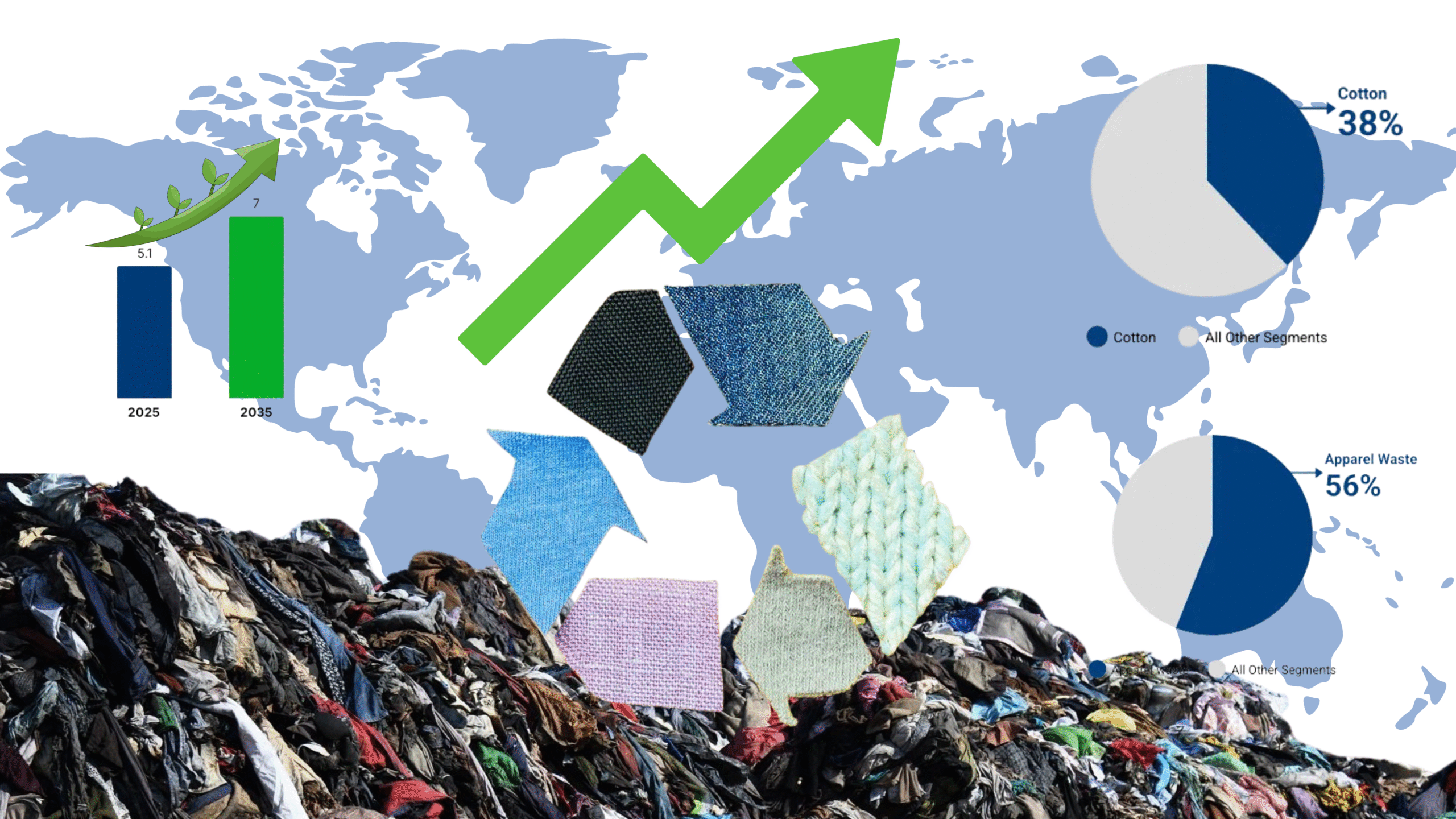
Recent research from Future Market Insights shows the global textile recycling market is projected to grow from USD 5.1 billion in 2025 to approximately USD 7.0 billion by 2035, at a compound annual growth rate (CAGR) of 3.2 % over that period.
Within that landscape:
- Apparel waste is expected to account for around 56 % share of textile recycling inputs in 2025 (i.e. post-consumer garments, manufacturing offcuts, unsold inventory).
- Recycled cotton is forecast to hold ~38 % of the material share by 2025.
- Among national markets, China is predicted to grow at ~3.8 % CAGR over 2025–2035, reaching about USD 1.49 billion in textile recycling revenue by 2035.
- India’s market is also expected to expand, with a projected CAGR of ~4.0 % and revenues reaching USD 0.53 billion by 2035.
- In the U.S., the textile recycling sector is forecast to grow at ~2.8 % CAGR, arriving at USD 1.29 billion by 2035.
- FMI opines that the United Kingdom textile recycling sales will grow at nearly 2.9% CAGR through 2025 to 2035 and is expected to reach USD 0.26 billion by 2035.
- FMI opines that Germany’s textile recycling sales will grow at nearly 3.5% CAGR through 2025 to 2035 and are expected to reach USD 0.96 billion by 2035.
- FMI opines that the France textile recycling sales will grow at nearly 3.4% CAGR through 2025 to 2035 and is expected to reach USD 0.80 billion by 2035.
- FMI opines that the Italy textile recycling sales will grow at nearly 3.1% CAGR through 2025 to 2035 and is expected to reach USD 0.66 billion by 2035.
- FMI opines that the Australia & New Zealand textile recycling sales will grow at nearly 2.7% CAGR through 2025 to 2035 and is expected to reach USD 0.32 billion by 2035.
- FMI opines that South Korea’s textile recycling sales will grow at nearly 3.6% CAGR from 2025 to 2035 and is expected to reach USD 0.37 billion by 2035.
- FMI opines that the Japanese textile recycling sales will grow at nearly 2.9% CAGR from 2025 to 2035 and is expected to reach USD 1.28 billion by 2035.
These figures suggest a steady, if not explosive, pace of growth. The projections reflect both latent demand and the recognition that recycling must scale if the textile sector is to reduce its environmental burden.
One of the key factors contributing to this market expansion is the increasing demand for sustainable textiles. Consumers are becoming more conscious of their environmental impact and are seeking out eco-friendly products. A report from GlobalData indicates that 60% of consumers are willing to pay more for sustainable products, including those made from recycled materials. As a result, brands are under growing pressure to integrate recycling into their supply chains.
The Role of Technology in Textile Recycling
Technological advancements are pivotal in improving the efficiency of textile recycling processes. Companies like Circ® and FiberTrace are using innovative techniques to make recycling more viable on an industrial scale. Circ® has pioneered the recycling of polycotton blends, a fabric traditionally difficult to recycle, into high-quality polyester fibers. This not only reduces the environmental impact of cotton and polyester production but also opens new markets for recycled materials.
FiberTrace is another example of a company leading the way in the textile recycling sector. They have developed a system that uses traceable markers in fibers to enhance the transparency and traceability of the recycling process. This technology ensures that recycled materials can be tracked and verified, which is crucial for building trust in recycled products.
Challenges in the Textile Recycling Market
While the growth prospects for textile recycling are promising, several challenges remain. One of the primary obstacles is the complexity of textile waste. Textiles made from mixed fibers, such as cotton-polyester blends, are difficult to recycle effectively using traditional methods. Recycling these materials requires specialized technologies that are still in the early stages of development and require significant investment.
The cost of chemical and enzyme-based recycling methods is another barrier to market growth. According to a study by the Ellen MacArthur Foundation, recycling textiles can be up to three times more expensive than producing new fabrics. Despite this, the demand for recycled materials continues to grow, and companies are working to reduce the costs associated with textile recycling processes.
The Future of Textile Recycling
As the demand for recycled textiles increases, there is a growing emphasis on improving recycling technology and scaling it for mass production. Companies such as Renewcell and Worn Again Technologies are at the forefront of these efforts. Renewcell has developed a technology that can recycle cotton-based textiles into new fibers, while Worn Again Technologies is working on a process to separate polyester from cotton in textile waste.
“The recycling industry is facing a unique opportunity to reshape the future of textiles,” says Peter Majer, CEO of Worn Again Technologies. “By making textile recycling more economically viable, we can ensure that the materials in our clothing are kept in circulation for longer, reducing the environmental impact of the fashion industry.”
As the market grows, governments are also expected to play a crucial role by introducing policies and incentives that support textile recycling. Many countries have already introduced extended producer responsibility (EPR) schemes, which require manufacturers to take responsibility for the recycling of their products. These initiatives are expected to push the industry toward more sustainable practices and accelerate the development of efficient recycling technologies.
The textile recycling market is poised for continued growth as both the demand for sustainable products and the need to reduce waste intensify. Companies are investing in innovative technologies to make recycling more effective and economically viable. While challenges remain, the market’s expansion reflects a broader shift towards sustainability in the textile industry, one that could have a profound impact on the environment. As consumer preferences continue to evolve, textile recycling will play an increasingly important role in the industry’s transition to a circular economy.


