
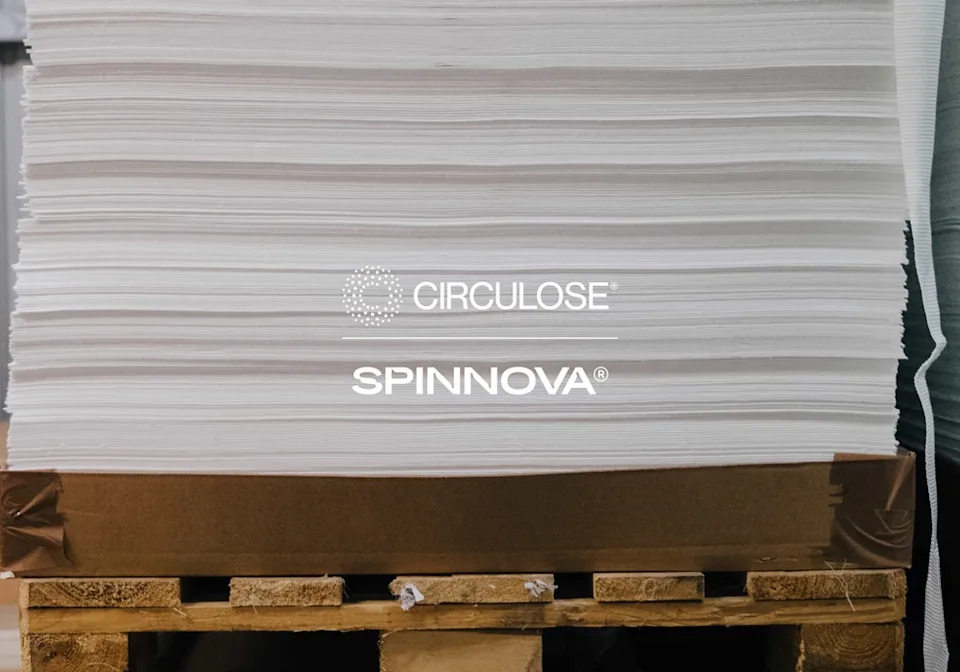
Circulose and Spinnova are working together again as they look to bring textile-waste-based fibers closer to wider market use. The Swedish recycler and the Finnish fiber technology company previously collaborated when Circulose operated under the name Renewcell. After a period marked by financial and strategic challenges for both companies, they are now restarting their partnership with a renewed focus on scaling production.
The collaboration centers on using Circulose’s cellulose-rich dissolving pulp as a raw material in Spinnova’s fiber production process. Circulose pulp is produced from cotton-rich textile waste, including both pre- and post-consumer garments. The goal is to turn discarded textiles into new fibers that can be used again in clothing and other textile products.
Spinnova’s technology relies on a mechanical process that converts cellulose pulp directly into fiber. Unlike conventional man-made cellulosic fiber production, which typically involves dissolving the pulp in chemicals, Spinnova’s approach forms fibers without toxic solvents and without dissolving the material during spinning. According to the companies, Circulose pulp can be used at 100 percent in the process, eliminating the need for virgin wood pulp and increasing the recycled content of the final fiber.
Earlier trials between the two companies in 2023 showed that Circulose pulp could be successfully spun into fibers that were then turned into yarn and fabric. The renewed partnership aims to deepen that technical integration while also expanding opportunities within Spinnova’s wider industry network. Partners in this ecosystem include Portuguese yarn spinner Tearfil Textile Yarns and the American fashion brand Tommy Hilfiger.
Circulose CEO Jonatan Janmark said the company sees strong potential for man-made cellulosic fibers to play a larger role in the textile sector. He noted that Spinnova’s technology offers both sustainability advantages and performance properties that can appeal to brands looking for alternative fiber sources.
Spinnova CEO Janne Poranen said the collaboration helps secure a supply of circular raw materials while giving Circulose another pathway to expand the use of its pulp. As interest in textile-waste-based materials grows, he said combining recycled pulp with Spinnova’s process could help move fiber production closer to commercial scale.
Both companies are entering this new phase after a difficult period. Spinnova reported a challenging financial year in 2025, with revenue falling by 54 percent to 344,000 euros. At the same time, the company’s expenses rose significantly as it continued to develop its technology and production capabilities. A major setback came when its Woodspin joint venture with Brazilian pulp producer Suzano was terminated, resulting in an impairment loss of 18.4 million euros.
Poranen said the experience led Spinnova to reassess its strategy. The company is now focusing on improving the cost efficiency of its production process, expanding its raw material base, refining fiber properties, and building a broader international partner network.
Circulose has also gone through a period of transition. The company restarted full-scale production at its Ortviken plant in Sundsvall in the fourth quarter after securing new demand commitments from several fashion brands, including Bestseller, C&A, Filippa K, John Lewis, and Reformation. The restart came under new ownership from private equity firm Altor, which acquired the business after Renewcell entered bankruptcy.
In its earlier phase, the company struggled with inconsistent demand from major retailers, including former key supporter H&M Group. While interest in recycled and lower-impact materials is increasing, especially with upcoming European Union ecodesign regulations, adoption across the fashion industry remains uneven.
Janmark said Circulose has been working to build stronger partnerships across the supply chain to support stable growth. The company has signed agreements with fiber producers such as Aditya Birla, Tangshan Sanyou, and Jilin Chemicals to expand production capacity and integrate its pulp into existing fiber manufacturing systems.
Production preparations are currently underway at the Ortviken facility, with new pulp expected to roll out later this year. Circulose says the restart was timed to match confirmed demand, with commitments from 11 brands now in place.
Through their renewed partnership, Circulose and Spinnova hope to show that textile waste can become a reliable raw material for fiber production while fitting into existing textile supply chains that brands already rely on.


