
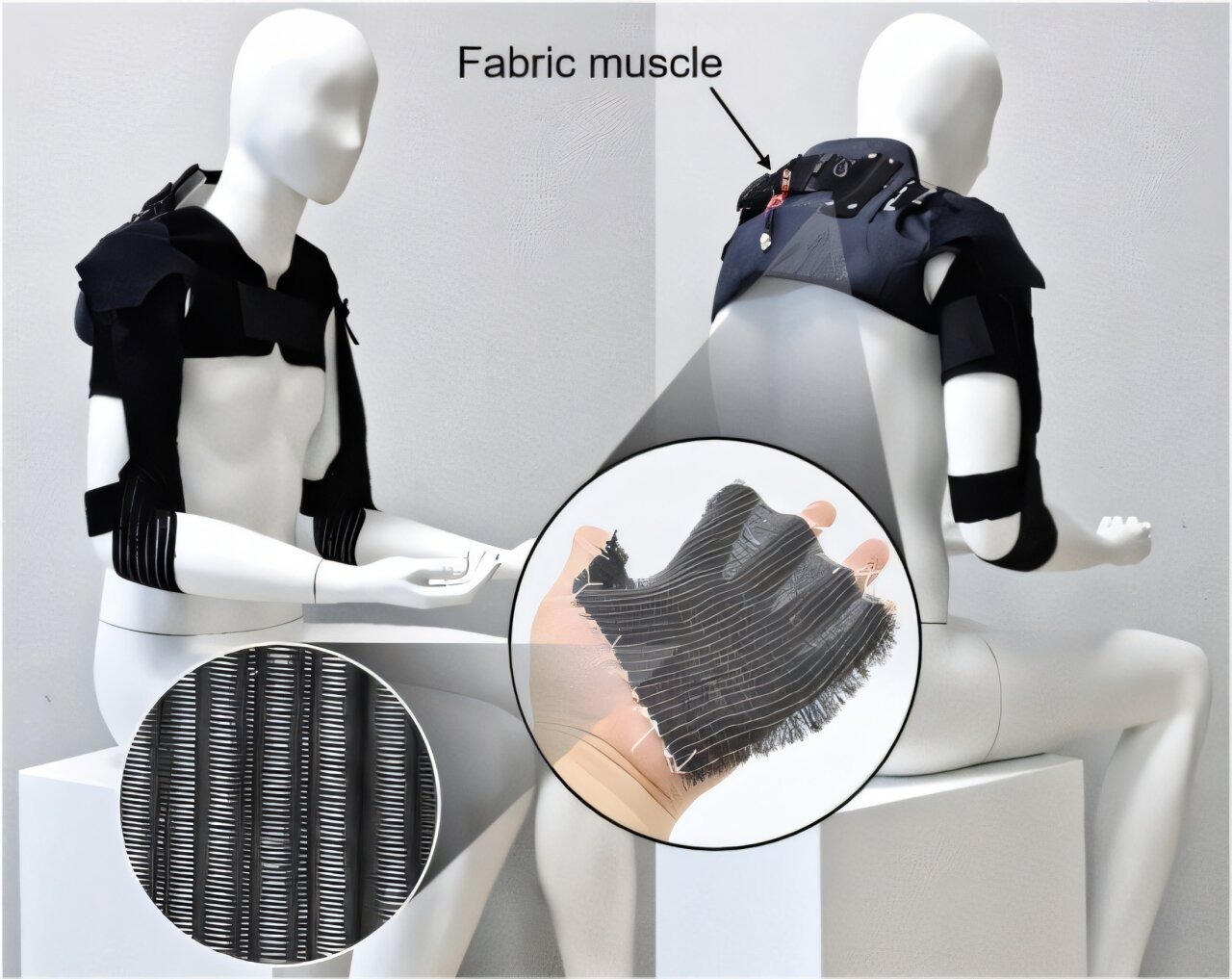
A new textile actuator technology developed by researchers at École Polytechnique Fédérale de Lausanne is opening fresh possibilities for wearable robotics, medical garments, and assistive apparel systems.
The innovation integrates Nickel-Titanium shape memory alloy fibres directly into flexible textile structures. These fibres behave like artificial muscles. When activated by a low-voltage electrical current, the fabric contracts and produces controlled mechanical motion while remaining soft, lightweight, and breathable.
The research was carried out at EPFL’s Soft Transducers Lab (LMTS), where scientists focused on solving one of wearable robotics’ biggest challenges. It combines strong mechanical performance with everyday garment comfort.
Lightweight textile delivers powerful motion
Researchers demonstrated that a textile actuator weighing only 4.5 grams can contract by 50 percent and lift a 1 kg load. The fabric generates lifting power more than 400 times its own weight.
Traditional wearable robotic systems depend on motors, cables, or pneumatic devices. These components add bulk and restrict natural body movement. Textile actuators offer an alternative approach by embedding motion capability directly into fabrics, allowing garments to function as active mechanical systems.This advancement moves wearable robotics closer to real clothing applications rather than laboratory prototypes.
New textile architecture improves efficiency
The research team, led by Huapeng Zhang and Herbert Shea, redesigned how shape memory alloy fibres interact within textile structures.
Conventional knitted designs often create internal friction where fibres pull against each other, reducing force efficiency. The researchers introduced a periodic X crossing fibre architecture that aligns fibre intersections with the intended motion direction.
This structure allows forces to combine efficiently, improving actuator performance and reducing motion instability. The textile can stretch up to 160 percent of its original length, ensuring flexibility and wearer comfort.
Wearable prototypes show practical applications
To validate real-world use, the team developed functional wearable prototypes.
A robotic sleeve assists elbow movement and can smoothly lift a 1 kg object. Another prototype compression garment applies controlled pressure suitable for lymphedema treatment or circulation enhancement in performance apparel.
The system also offers bistable energy efficiency. Once compression is achieved, the fabric can maintain pressure without continuous power consumption. This feature is critical for battery-powered wearable devices intended for long daily use.
Smart textiles move toward active systems
Alongside hardware development, researchers introduced a predictive mechanics model to analyze the thermomechanical behavior of shape memory alloy fibres. This enables engineers to design scalable textile actuators with customized force output and improved reliability.
The innovation reflects a broader transformation across textile engineering. Fabrics are evolving from passive materials into responsive systems capable of movement, assistance, and adaptive performance.
Industry observers expect such actuator textiles to accelerate innovation in rehabilitation wearables, elderly care support garments, and industrial exosuits that help prevent musculoskeletal injuries.
For Bangladesh’s textile and apparel industry, advancements like Shape Memory Alloy (SMA) based actuator textiles highlight an emerging opportunity beyond conventional manufacturing. As global apparel shifts toward functional and smart clothing, future competitiveness may increasingly depend on the integration of advanced materials, electronics, and textile engineering expertise.


