
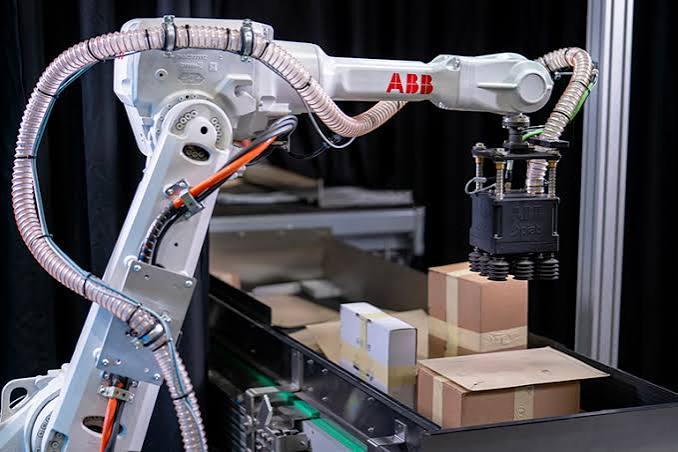
ABB Robotics has introduced its first end-to-end vision-based physical AI solution for industrial applications, integrating AI Robot Trainer into its Fashion Inductor module to help system integrators deploy, scale and continuously optimize automated fashion logistics operations. The solution is designed to reduce engineering effort, shorten commissioning time and lower project risks in environments where products, packaging and operating conditions vary continuously.
Fashion Inductor combines robotic picking, sorting and vision technology to handle the high variability of fashion and apparel logistics. With the addition of AI Robot Trainer, ABB aims to make these applications easier to deploy and maintain while enabling robotic systems to adapt to changing operational requirements without requiring specialist AI expertise.
Reducing engineering effort in fashion logistics
Fashion and apparel logistics present particular challenges for automation because items can differ significantly in size, shape, packaging and presentation. These variations can make conventional automation difficult to deploy and maintain consistently.
Fashion Inductor is designed to address these challenges, delivering throughput of up to 1,300 items per hour per cell, with picking accuracy targets above 99.5%. Its performance is supported by ABB Robotics’ AI-powered Automatic Path Planning, motion accuracy and application-specific vision technology.
The integration of AI Robot Trainer adds vision-based physical AI capabilities, with ABB reporting that engineering and commissioning effort can be reduced by up to 75%. The system provides pre-trained, fashion-specific AI vision models, application-specific tools and rapid retraining capabilities, allowing system integrators to adapt applications as products and operating requirements change.
These capabilities are intended to simplify deployment and ongoing optimization, reducing the amount of manual engineering required to configure and maintain automated picking and sorting systems.
Digital twin supports commissioning and integration
The upgraded Fashion Inductor also introduces a digital twin that replicates the module’s software environment. It connects the Application Controller Platform, Automatic Path Planning, AI Robot Trainer and RobotStudio®, ABB Robotics’ software platform for virtual design, simulation and validation.
The digital twin is designed to accelerate commissioning and provide greater flexibility during system configuration. It also supports the integration of third-party components, including grippers, helping system integrators configure applications around specific operational requirements.
By connecting simulation, application development and robot operation, the system provides a more integrated approach to preparing and deploying automated logistics applications.
Continuous improvement throughout the system lifecycle
Beyond initial deployment, AI Robot Trainer supports ongoing model improvement as operating conditions and performance requirements evolve.
The system uses a closed-loop workflow to monitor robot performance, identify anomalies, generate new training data and deploy updated models back to the physical robot. This allows AI models to be retrained for individual cells and refined against real operating conditions and performance targets.
ABB Robotics’ RobotStudio platform provides the foundation for virtual design, simulation and validation, while its OmniCore™ robot controller serves as the execution layer in production. Together, these platforms support the development, deployment and continued optimization of robotic applications throughout their operational lifecycle.
Craig McDonnell, Managing Director, Business Line Industries at ABB Robotics, said the technology addresses applications that have traditionally been difficult to automate because of high variability.
“Physical AI fundamentally changes what robots can do in industrial applications,” McDonnell said. He added that Fashion Inductor with AI Robot Trainer demonstrates how intelligent automation can be deployed, operated and continuously optimized at industrial scale, helping system integrators accelerate deployment, reduce project risk and maintain performance over time.
Expanding vision-based physical AI across robotics
Fashion Inductor represents the first step in ABB Robotics’ broader rollout of vision-based physical AI as part of its Autonomous Versatile Robotics (AVR™) development programme.
The company plans to extend the AI Robot Trainer-powered approach to additional vision-based robotics applications through the first quarter of 2027. The expansion is intended to bring adaptive capabilities and lifecycle management to a wider range of robotic systems.
For fashion and apparel logistics operators, the development focuses on making automated picking and sorting easier to deploy and adjust as product mixes and operating conditions change. By combining vision technology, simulation, robotic control and continuous model retraining, ABB Robotics is seeking to address some of the practical challenges involved in scaling automation across variable logistics environments.
-

-

-

-

