
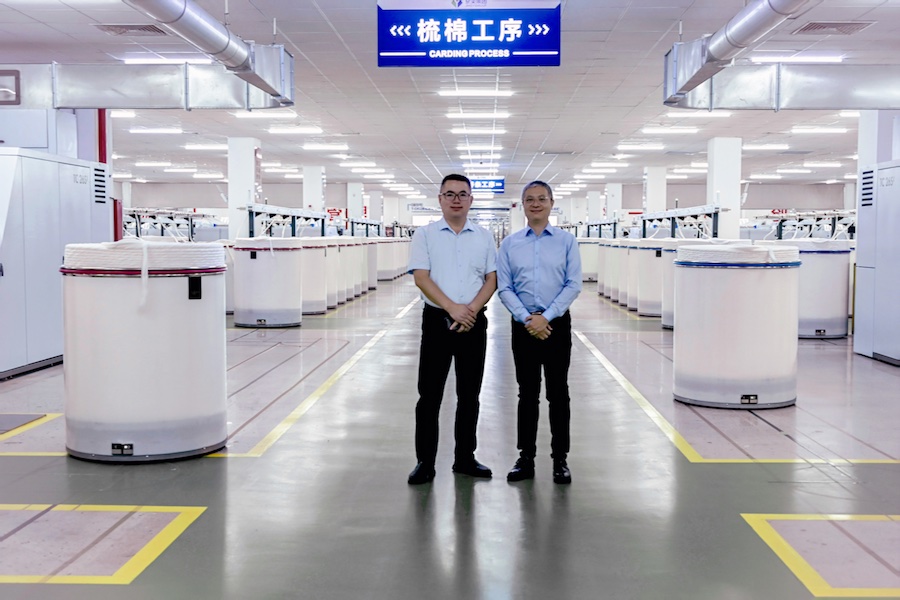
As textile manufacturers seek to reduce labour dependency without compromising production efficiency, automated material handling is becoming increasingly important. Trützschler’s T-CAN automated can transport system is helping mills address this challenge by connecting carding and drawing processes, ensuring a continuous flow of material while reducing manual handling.
One of the first companies to adopt the system was Jiangsu Jingyi Green Energy New Materials Technology Co., Ltd., part of Jingyi Group. The company specialises in recycled, biodegradable and functional vortex-spun yarns, with a strong focus on advanced manufacturing and sustainable textile production.
Looking to improve material handling and streamline its spinning preparation operations, Jingyi initially introduced T-CAN through a pilot installation. Following positive results, the company decided to expand the system into series production, deploying approximately 3,600 T-CAN units.
More than 35,000 can movements daily
More than two years after its first installation, T-CAN is handling over 35,000 can movements per day at Jingyi, equivalent to approximately 1,750,000 kg of material handled through the system.
The automated solution uses intelligent route planning and dispatching to ensure that each can reaches its designated destination at the right time. Its continuous 24-hour operation supports stable material flow and consistent production quality.
The most significant improvement has been in labour efficiency. By removing the need for manual can transportation, employees can focus on other production activities.
“By eliminating manual can transport, operators can focus on other value-adding activities. Today, one operator can handle twice as many cards as before. Similar improvements have been achieved in draw frame operations. Overall, this has reduced our labour requirements in spinning preparation by more than 60%,” says Kong Guoqing, Factory Director at Jiangsu Jingyi Green Energy New Materials Technology Co., Ltd.
For mills dealing with labour shortages and high employee turnover, reducing dependence on manual material handling also offers greater operational stability.


Further expansion planned
Encouraged by the system’s performance, Jingyi has already decided to expand its T-CAN installation. A follow-up project involving 1,080 additional units is scheduled for installation later this year.
The experience at Jingyi demonstrates the practical benefits of automating material transport in spinning preparation. By connecting machines and ensuring reliable material movement, T-CAN helps manufacturers improve workforce utilisation, maintain production continuity and manage large-scale operations with fewer manual interventions.
As textile mills continue to address labour constraints and rising production demands, automated can transport is becoming an increasingly relevant part of modern spinning preparation.


