
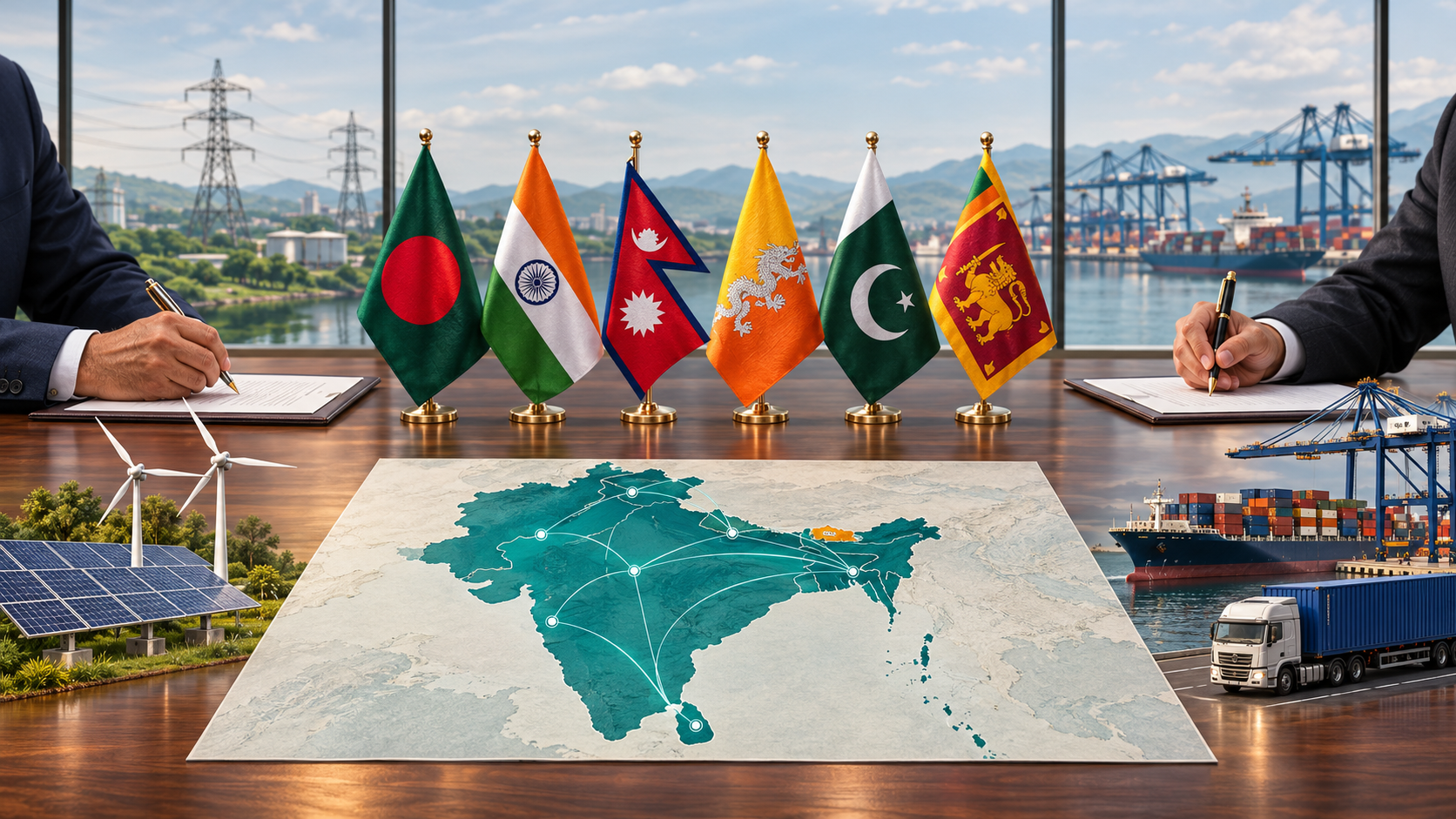
A buyer ordering winter jackets cares whether the fabric mill, dyehouse and sewing floor can all meet the shipping date. A power cut at one mill can leave workers across a border waiting for cloth. The eight members of the South Asian Association for Regional Cooperation (SAARC) could win more manufacturing orders worldwide if a buyer can choose suppliers across the region and count on the same delivery date. That requires trading electricity as readily as yarn, components and finished goods.
Bangladesh’s garment exports earned US$13.71 billion in July–October 2026. Sri Lanka’s electrical and electronic component exports reached US$566 million in January–October, up 59.6% in a year. A regional grid would buy cables and switchgear from some of the same factories whose exports it helps sustain.
Table 1. Merchandise exports and wage benchmarks across SAARC, November 2026
| SAARC member | Goods exports, 2026 | Wage benchmark and coverage |
| Afghanistan | US$667m · Apr–Sep | AFN 295/day, unskilled, early October |
| Bangladesh | US$17.04bn · Jul–Oct | BDT 12,500 → 17,000/month, garments, proposed for December |
| Bhutan | BTN 14.66bn · Jan–Mar | BTN 125/day, national floor |
| India | US$309.06bn · Apr–Oct | INR 512.50 → 524.50/day, Gujarat Zone I, unskilled |
| Maldives | US$23.71m · Jul–Sep | MVR 21.63, 33.65, 38.46/hour, Maldivians in small, medium, large firms |
| Nepal | NPR 134.14bn · mid-Jul–mid-Nov | NPR 17,300 → 19,550/month, general, excluding tea plantations |
| Pakistan | US$11.51bn · Jul–Oct | PKR 40,000 → 43,000/month, Sindh, unskilled |
| Sri Lanka | US$12.01bn · Jan–Oct | LKR 27,000 → 30,000/month, national floor |
Periods differ. Bhutan includes electricity, and Maldives reports domestic exports excluding re-exports. Wages use local currencies. Afghanistan reports observed earnings, Bangladesh a proposal, and other countries statutory rates for the workers shown.
A higher wage can coexist with a lower cost per shirt if paid hours produce more shirts. Lose one hour of a ten-hour shift and labour cost per unit rises 11.1% at unchanged pay and hourly output. Add a 10% wage increase and the rise reaches 22.2%. An Indian manufacturing study estimated that shortages cost the average plant 5–10% of revenue. In Yaobin Wang’s South Asian study, a one-standard-deviation rise in import concentration amplified the estimated growth penalty from supply imbalances by 18–24%.
An electricity market built around the factory shift
A rise in imported gas prices hits a textile mill twice, through its electricity bill and the boiler that heats its dye baths. Rationing can leave both idle. In Pakistan, capacity payments reached PKR 1.8 trillion in FY2024/25 even as imported-coal plants averaged 23% utilisation. Rooftop solar displaces fuel while fixed charges remain payable. Negotiate plant retirements and publish the savings after compensation.
Figure 1. How the power system affects manufacturing, trade and investment


Nepal can sell 40 megawatts to Bangladesh through India during the wet season. In FY2025/26 India bought 7.89 billion kilowatt-hours from Bhutan and sold it 2.12 billion. Two-way trade lets Bhutan power factories in dry months. Use the 2014 SAARC electricity agreement to publish transmission capacity and transit fees, auction evening supply from hydro, wind and batteries, and compensate factories for outages. Maldives can apply the same reliability standard to island solar, batteries and ice storage for tuna processors. Solar cold rooms would give Afghan fruit exporters more time to reach an open border.
Build the equipment as well as the grid. India added 50.6 gigawatts of module manufacturing capacity against 9.7 gigawatts of cell capacity in the first half of 2026. Bangladesh could assemble and test modules, Pakistan could repair inverters and motors, and Nepal and Bhutan could refurbish turbines. Regional orders large enough to justify a testing laboratory would help smaller suppliers qualify. Require interchangeable parts, local warranties and apprenticeships. Of US$46 billion in foreign direct investment entering South Asia in 2025, India received US$39 billion. A guaranteed grid connection can help another location compete. Sri Lanka’s US$150 million energy programme aims to mobilise over US$800 million in private capital.
How much of a crude discount can India share?
A diesel agreement could protect production while the grid is built. Through October 2026, Iranian Heavy averaged US$93.94 a barrel and ten monthly Russian Urals assessments averaged US$78.53. India’s actual Russian imports in April averaged US$117.60 for 1.64 million barrels daily. Its US$430.5 million Iranian import bill and estimated arrivals of 133,000 barrels daily imply roughly US$108 per barrel. Customs and tanker dates can differ.
Chinese refiners previously obtained Iranian Light at US$10 below Brent. Indian buyers received premium offers in March. Treat US$6–10 below Brent as a negotiating scenario. Table 2 tests a more ambitious Iranian discount of 20–30% against assumed US$90 Brent. Trade requires lawful supply, payment and insurance after the July waiver revocation.
Table 2. Diesel discounts an Indian refinery could fund from cash margins
| Crude case | Crude price | Diesel cash cost | Max discount at 2% margin | Max discount at 3% margin |
| Iran, 20% off | 72.00 | 67.50 | 49.3% | 48.8% |
| Iran, 25% off | 67.50 | 56.25 | 57.7% | 57.3% |
| Iran, 30% off | 63.00 | 45.00 | 66.2% | 65.8% |
| Russian Urals | 78.53 | 93.83 | 29.5% | 28.8% |
US$/barrel. Add US$4 for Iranian delivery or US$8 for Russian delivery and US$8 for processing and finance. Each crude barrel yields 0.40 diesel barrels and 0.60 other barrels sold at US$95. Margins divide cash earnings by sales revenue. They exclude fixed overhead and tax.
A 25% Iranian discount puts diesel cash cost at US$56.25. Yet selling finished diesel at 30–50% off Singapore’s US$135.82 benchmark sacrifices US$35.13–62.29 per barrel against India’s US$130.20 alternative export. A 2% discount preserves US$2.90 of additional receipts, a 2.23% uplift. A supplier seeking a 3% uplift could offer about 1.26% off.
Bangladesh’s advantage depends on the depot
Table 3. Delivering 50-ppm diesel to northern Bangladesh, US$/barrel
| Route to Parbatipur | Fuel base | Import premium | Inland cost | Depot cost |
| Sea, Jan–Jun terms | 135.67 | 5.33 | 2.64 | 143.64 |
| Sea, Jul–Dec terms | 135.67 | 9.50 | 2.64 | 147.81 |
| Existing pipeline terms | 135.67 | 5.50 | 0.00 | 141.17 |
| Pipeline, 2% off base | 132.96 | 5.50 | 0.00 | 138.46 |
All rows use US$135.67, the 26 November Singapore 50-ppm quote, to isolate route costs. BPC’s seaborne tender uses a five-day Arab Gulf average. The pipeline also references Arab Gulf gasoil. Actual invoices depend on their fixing dates.
At second-half terms, Chattogram costs US$145.17 including the import premium. BPC’s published CIF tender includes freight and insurance and bills lighterage to the supplier. Add only documented extra terminal costs or demurrage. Onward transport costs US$2.64. At the approved 180,000 tonnes, or 1,342,800 barrels, the discounted pipeline saves US$12.56 million annually against that seaborne route. US$9.01 million reduces external invoices if premiums are paid abroad. The balance covers domestic transport. Against existing pipeline terms the additional saving is US$3.64 million. Coastal buyers need their own port comparison.
What seven buyers save and India earns
Figure 2. From discounted crude to annual foreign-currency gains on diesel


Table 4. Annual foreign-currency effects of a one-million-barrel regional tender
| Buyer | Annual barrels (000) | Buyer saves US$000 | India bills US$000 | India gains US$000 |
| Afghanistan | 10 | 27.20 | 1,331.00 | 29.00 |
| Bangladesh | 277 | 753.44 | 36,868.70 | 803.30 |
| Bhutan | 60 | 163.20 | 7,986.00 | 174.00 |
| Maldives | 2 | 5.44 | 266.20 | 5.80 |
| Nepal | 425 | 1,156.00 | 56,567.50 | 1,232.50 |
| Pakistan | 10 | 27.20 | 1,331.00 | 29.00 |
| Sri Lanka | 216 | 587.52 | 28,749.60 | 626.40 |
| Total | 1,000 | 2,720.00 | 133,100.00 | 2,900.00 |
US-dollar equivalents at rounded barrel prices. India’s billings exclude delivery. Its gain is incremental export receipts versus selling the same output elsewhere. Hold imported inputs and foreign freight costs constant.
Table 4 prices additional regional orders for 10-ppm diesel at 98% of Singapore’s 26 November assessment. Each buyer saves US$2.72 per barrel if competing delivery costs match. Five allocations reflect India’s 2025 refined petroleum trade by weight, including products beyond diesel. Afghanistan and Pakistan each receive a conditional 10,000-barrel lot requiring trade, transit and payment arrangements. With neither lot traded, buyers save US$2.666 million and India gains US$2.842 million.
Bangladesh’s 277,000-barrel illustration and its existing pipeline contract are separate comparisons. Repricing an existing Indian export cuts India’s receipts on that order. Check competing bids at the same depot, grade and payment date. Every extra dollar of foreign freight cuts the buyer’s saving by one dollar per barrel if passed through. Actual reserve effects depend on settlement currency and imported inputs.
The rules South Asia needs to trade power and fuel
A Bangladeshi mill buying Nepalese hydropower through India needs to know what transmission will cost and whether it can count on that power for the evening shift. Article 12 of the 2014 SAARC Framework Agreement for Energy Cooperation already provides for non-discriminatory grid access. India and its neighbours should put that commitment into practice through a regional electricity protocol that aligns national trading rules, publishes available transmission capacity and transit charges, and sets clear terms for supply cuts and compensation. Under Articles 7 and 8 of the South Asian Free Trade Area agreement, members should also review tariffs and simplify customs procedures for solar cells, inverters, transformers and spare parts. Recognising one another’s testing certificates would help regional manufacturers qualify for orders across borders. Diesel requires a separate purchasing and transit agreement, open to all eight members.
As the Parbatipur example shows, buyers can judge a discount only when bids specify the same fuel grade, pricing dates and delivery point, with freight and unloading shown separately. India and Pakistan should negotiate any exemptions needed for agreed shipments, including transit to Afghanistan. Each participating country should have a vote on emergency allocations and access to independent arbitration. Fuel contracts should expire or face competitive renewal, with an agreed share of verified savings financing transmission lines, storage and repair workshops that keep the next factory shift running.
Writer
Enamul Hafiz Latifee
Strategic & Reporting Lead, Textile Innovation Exchange (TIE)
-

-

-

-

