
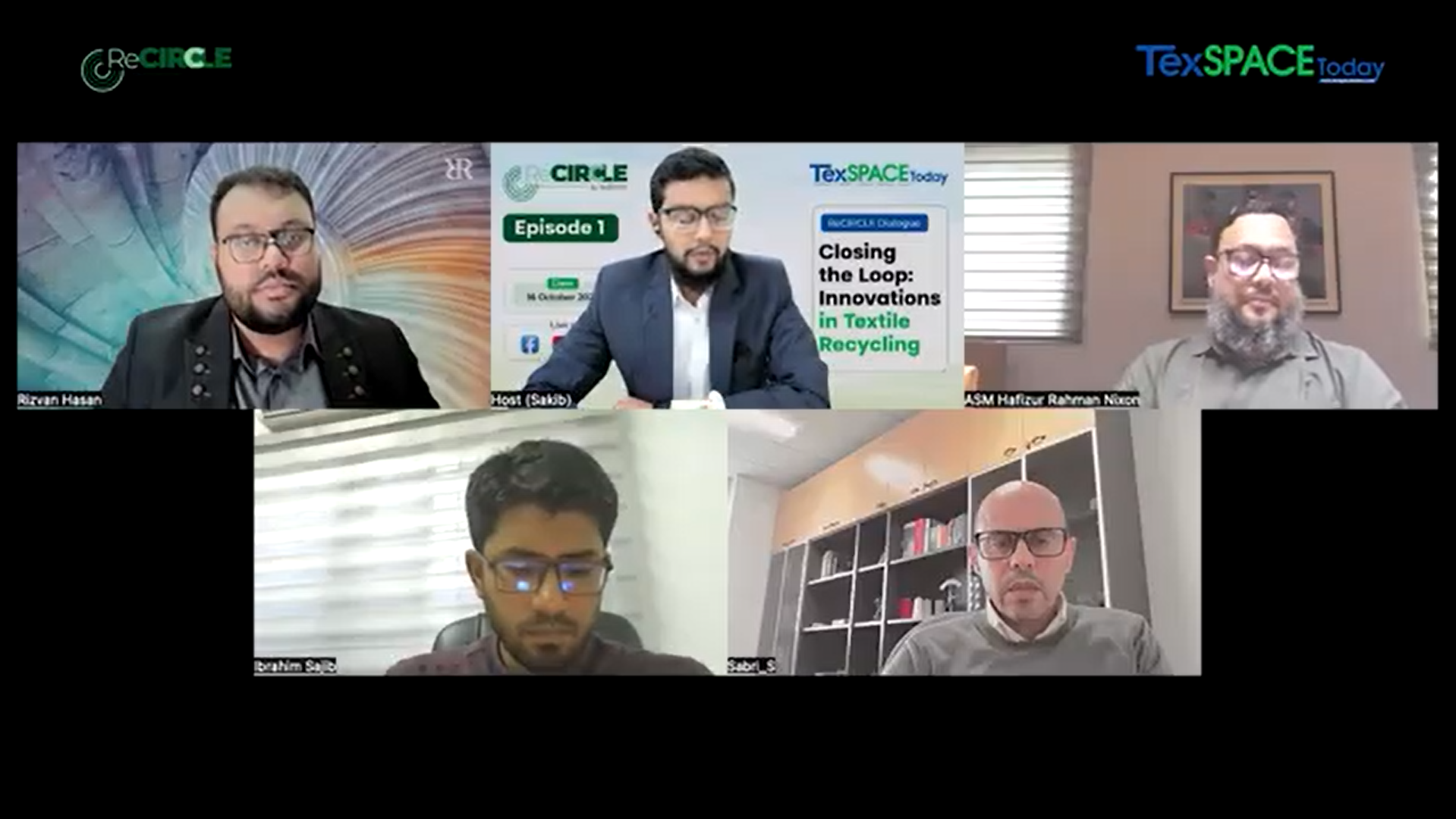
The first episode of the ReCIRCLE series by TexSPACE gathered an expert panel of global leaders in textile recycling to explore the current state of the circular textile economy, with a focus on innovation, challenges, and actionable insights.
With the textile industry generating an estimated 92 million tons of waste annually, and less than 1% of these materials being recycled back into new products, the discussion underscored the urgency of shifting towards a circular model. The session provided a deep dive into technological advancements, policy challenges, and the role of digitalization in driving sustainable change in textile recycling. The webinar is moderated by Najmus Sakib, Sub Editor, TexSPACE Today.
Innovations in mechanical recycling for maximsing fiber value
The first segment addressed the challenges and innovations in mechanical recycling, which historically struggled with fiber length retention, particularly for blended materials.
Hafizur Rahman Nixon, Executive Director at RH Corporation, acknowledged the limitation of traditional mechanical recycling, which often produces short, weak fibers suitable only for non-woven or technical textiles. RH Corporation, which partners with global machinery and technology providers like Dell’Orco & Villani (machinery), Valvan (AI sorting), and Pierret (cutting), is focused on optimizing the process to retain better fiber length and consistency.


Hafizur Rahman Nixon Nixon detailed specific technological advancements:
- AI-Based Automated Sorting: To counter the “garbage in, garbage out” principle, RH Corporation promotes AI-based sorting systems from Valvan that offer 95% accuracy in separating feedstock by color and fiber composition.
- Precision Cutting: The use of world-class machinery from Pierret double cutting and cross-cutting systems ensures homogeneous cutting, which is vital for maintaining staple fiber length and reducing uneven load and energy consumption during the subsequent opening process.
- Advanced Opening/Tearing: Unlike competitors who use traditional 944mm drum sizes, Dell’Orco & Villani equipment features a 1240mm drum. This larger size allows for less friction, less energy consumption, and enhanced safety due to a lower RPM. The machines are also equipped with advanced systems to automatically reject contaminants like zippers and buttons.
- Process Customization: RH Corporation emphasizes customizing the entire machine layout and process based on the end-use requirements (post-consumer or pre-consumer waste) and the desired final yarn properties.
Hafizur Rahman Nixon Nixon stressed the importance of designing the fabric from the very beginning with recycling in mind, noting that combining recycled fiber with a small percentage of long-staple, dope-dyed virgin fiber can produce excellent yarn. He cited a study where this blended approach resulted in a 72% reduction in carbon emissions and 99% water savings compared to regular production.
Green chemistry for recycled fibers
The conversation then shifted to the chemical treatment required to make recycled fibers usable, a critical step often overlooked.
Said Sabri, Export Manager, BU Textile Specialties, Erca S.p.a, focused not on chemical recycling itself, but on supporting the use of recycled materials through truly sustainable chemical auxiliaries.


Erca’s innovation lies in its “Revecol®” range of products, which are derived from recycled vegetable cooking oil. By substituting fresh oils (like palm or castor oil used for pre-treatment, dyeing, and finishing) with used cooking oil, the company achieves two main goals:
- Significant Carbon Footprint Reduction: A specific leveling agent for polyester saved 72% in CO2 compared to Erca’s standard products.
- Enabling Circularity: The use of auxiliaries made from recycled materials provides a truly sustainable solution for treating articles, especially those made from recycled fibers.
Said Sabri mentioned facing challenges such as analyzing and removing residual acrylamide from the cooking oil and ensuring a reliable supply chain. However, their products are now certified by leading standards like blueSign®, ZDHC, and GOTS, positioning them as a Best Available Techniqu for high environmental protection.
Digitalization is in the core of circularity
Rizvan Hasan, Country Head for Bangladesh at Reverse Resources, articulated that the foundation of circularity is information and traceability, not just physical recycling. Reverse Resources is a Software-as-a-Service (SaaS) platform designed to digitize, connect, and scale global textile-to-textile recycling.
Rizvan Hasan explained why digitalization is critical:

- Solving Composition Uncertainty: Traditionally, waste handlers rely on manual sorting (“touch of the hand”) to determine composition, which is inaccurate and leads to rejected recycled materials. Traceability based on source data is the solution.
- The Digital Solution: Reverse Resources tracks materials from the brand order down to the waste generation. The brand or factory confirms the material composition (e.g., “blue color, 100% cotton”) in the digital platform at the source (the cutting room). This digital chain of custody ensures that when a recycler purchases the waste, they have 100% verified data on its composition.
- Market Efficiency: The platform acts as a neutral, global marketplace, connecting waste generators with recyclers both locally and internationally. Given that Bangladesh currently only recycles about 15% of its total textile waste generation, the remaining 85% must find its way to global recyclers—a process enabled by digital tracking.
- Policy Compliance and Design: Digital data provides brands with insights to design better. By seeing which colors or materials end up as waste, brands can adjust future collections to use existing scrap, creating limited “capsule collections” and preparing for regulations like Digital Product Passport (DPP) and EPR.
He strongly emphasized that a successful digital platform must be transparent, neutral, and international to prevent data manipulation and ensure trust among all global stakeholders.
Non-technical hurdles in sorting and logistics
The discussion concluded by focusing on the practical, non-technical hurdles that limit the supply of high-quality textile waste.
Ibrahim Sajib, Chairman, Recycle Raw Ltd., a company specializing in waste sorting, highlighted that while sorting is the bridge between waste and recycling, the industry faces severe constraints:
- Lack of Pre-Sorting: The biggest hurdle is the factory practice of inputting “multiple color and multiple composition” waste into a single bag. This makes a sorting company’s job extremely difficult, as even one kilogram of non-conform material can destroy a five- to ten-tonne lot. He called for pre-sorting at the factory’s cutting table to ensure single-color and single-composition bags.
- Infrastructure Crisis: Sorting companies lack a comfortable operational environment. They are not compatible neighbors for residential areas, and the lack of a dedicated industrial zone for this sector creates land crises and restricts growth.


- Logistical Challenges: Materials are often damaged during transport because they must be loaded onto a vehicle and then taken to a port for container loading, where they do not receive special attention. Loading the container directly from the warehouse premises would significantly protect material quality.
- Financial & Regulatory Burden: The low-profit margin of sorting companies is strained by high commercial bank interest rates (15-16%) and confusion over tax issues like Source Tax, which lack clear collection and payment frameworks in the sector.
A mandate for global change
The final segment explored the single most impactful change the panelists would mandate to accelerate textile circularity worldwide.
Hafizur Rahman Nixon noted that the practice in major recycling hubs like China, India, and Turkey often involves less scrutiny on exact compositions, which allows them to sell mixed materials across different value ranges. However, to advance, Bangladesh needs to leverage its strengths.
Hafizur Rahman Nixon called for ‘A Unified Global Textile Circularity Platform & Policy Framework’.
- This global platform would connect recyclers, brands, policy makers, and technology providers to align efforts and overcome regulatory and supply chain barriers.
- It would establish a global policy framework that removes trade barriers for recycled textile waste under strict environmental controls.
- It should incentivize local innovations like AI driven material sorting, digital fiber passports, and data sharing between recyclers and brands.
Hafizur Rahman Nixon concluded that Bangladesh, as the world’s second-largest apparel exporter, needs this system alignment. Policy gaps and trade barriers currently prevent access to the post-consumer waste needed for fiber-to-fiber production. By adopting this unified platform, Bangladesh can move from being just a production hub to becoming a circular innovation hub.
Said Sabri urged industry-wide adoption of sustainable chemical auxiliaries.
- He expressed hope that other chemical manufacturers would follow Erca’s example by producing auxiliaries based on recycled materials (like their Revecol® product derived from used cooking oil).
- The goal is to increase circularity in the chemical industry itself, thereby enabling manufacturers to treat their recycled articles with more sustainable products.
Rizvan Hasan suggested mandatory sustainability and circularity education for all.
- Rizvan Hassan argued that without consumer demand, the entire circularity movement will fail. While manufacturers and recyclers can work to reduce waste, if consumers do not have the demand for recycled products, brands will not place orders.
- He called for mandatory education on sustainability and circularity for every educated person globally. This would cultivate a generation that understands the necessity of the movement, generating the consumer demand needed to drive the market and make the planet green again.
With EU regulations like EPR and the DPP accelerating the global shift, Bangladesh must adapt and prepare to integrate post-consumer waste into its recycling strategy. Collaboration between technology pioneers, innovators, industry practitioners, and consumer awareness efforts is the key to unlocking the country’s potential and establishing it as a leader in sustainable, circular apparel production.
-

-

-

-

