
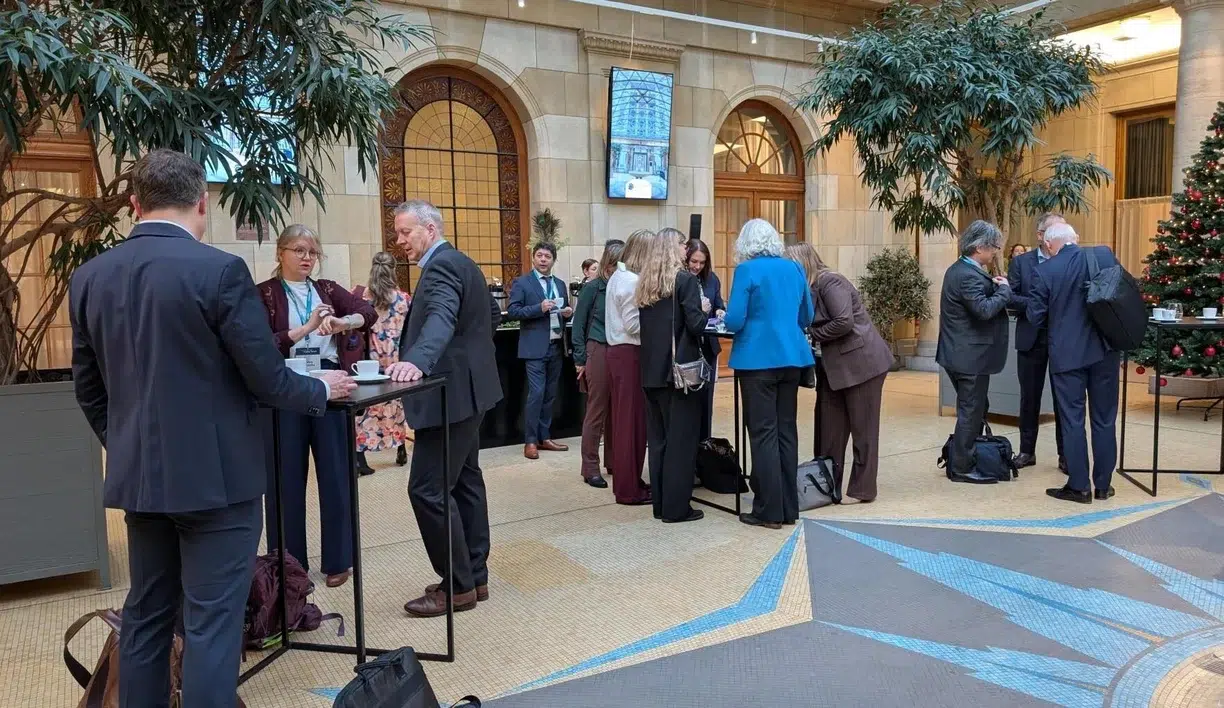
Against a backdrop of tightening environmental legislation, the EDANA Sustainability & Policy Forum 2025 wrapped up last week in Brussels with a clear focus on dialogue, reflection, and practical alignment. Held on 9–10 December at the Residence Palace, the two-day forum brought together leaders from the nonwovens industry, sustainability specialists, and European policymakers to discuss circularity and industrial competitiveness in a changing regulatory environment.
Rather than focusing on regulatory updates alone, the forum was designed as a space for deeper discussion. With EU policies evolving across chemicals, product design, waste, and climate due diligence, participants were encouraged to step back from day-to-day compliance and look at the broader direction of travel.
“From EDANA’s side, the primary goal of the Sustainability & Policy Forum is to create a dedicated space where industry, policymakers, experts and stakeholders can step back from day-to-day regulatory pressure and engage in more strategic, forward-looking discussions,” said Murat Dogru, General Manager of EDANA. He noted that the level of participation and the range of perspectives, particularly during the advocacy workshops, confirmed the forum’s value as a place for open and constructive exchange.


The event opened with a keynote by Sandrine Dixson-Declève, Co-Founder and Chair of the Systems Transformation Hub. Speaking on social and environmental tipping points, she addressed the current geopolitical context and questioned whether existing sustainability approaches are sufficient. Her message was direct: policy and economic decisions need to reflect human values if they are to respond to today’s systemic challenges.
Business leadership under regulatory pressure was the focus of the next major session. Ulrika Kolsrud, President and CEO of Essity, led a discussion on sustainability priorities in a period marked by calls for simplification and competitiveness. Joined by Murat Dogru, she explored how European industry can maintain high environmental ambitions while working within clearer, more proportionate regulatory frameworks. The discussion acknowledged that while sustainability expectations continue to rise, regulation must also support investment and innovation.
Several sessions moved beyond compliance and looked at how sustainability tools can support business decisions. Krishna Manda of Lenzing and Anna-Stina Reuter of Sphera discussed sustainability reporting as a driver of resilience and long-term value. Pia Hildén from Suominen encouraged companies to treat the CSRD as a strategic instrument rather than a box-ticking exercise. Ralf Weis of Freudenberg Performance Materials highlighted the need for clear and relevant data, especially for customers in durable nonwovens markets.
The link between textiles and nonwovens was explored in a panel featuring Lutz Walter (Textile ETP), Mireille Kong – Van Rekum (Indorama Ventures), and Christian-Yves Crépet (PETCORE Europe). The panel agreed that progress on circularity in Europe depends on shared infrastructure and aligned policy frameworks, not isolated sector efforts.
Technical topics were addressed in the afternoon sessions. Dominic Byrne of Plastics Europe and Thorsten Bies from Schlegel und Partner discussed developments in chemical recycling policy and technology. In the healthcare context, Tatiana Dias of DuPont argued for the legal recognition of mass balance approaches as a way to support circularity in medical packaging.
Day one closed with a networking dinner at the Musée BELvue, offering participants time to connect in a less formal setting and strengthen cross-industry relationships.
The second day placed advocacy and policy implementation at the center of discussion. Former EU official Hugo Maria Schally provided insight into how product policies are developed within DG Environment and how industry can engage effectively while maintaining safety and performance standards.
A key moment was the interactive EU Advocacy Workshop, where participants worked in smaller groups to examine EDANA’s active policy files. Topics ranged from the Waste Framework Directive to the Single-Use Plastics Directive, with open debate on where common industry positions are most needed.


One participant described the workshop as a shift from passive listening to active engagement, helping clarify where coordinated input from the industry could carry more weight in Brussels.
The forum concluded with a visit to the European Commission’s Conference Centre Albert Borschette. Participants met directly with Commission representatives, including Vincenzo Gente on the Waste Framework Directive and Ewa Malz on environmental policy simplification. The exchanges offered a clearer view of how legislation is shaped and where technical evidence can influence outcomes.
As one attendee reflected, hearing directly from policymakers helped demystify the process and showed that well-supported, data-driven input is taken seriously.
With new legislative packages expected in the coming year, the EDANA Sustainability & Policy Forum 2025 set a clear direction. EDANA reaffirmed its commitment to supporting members as they anticipate policy developments and align on science-based approaches to climate action and circularity.


